
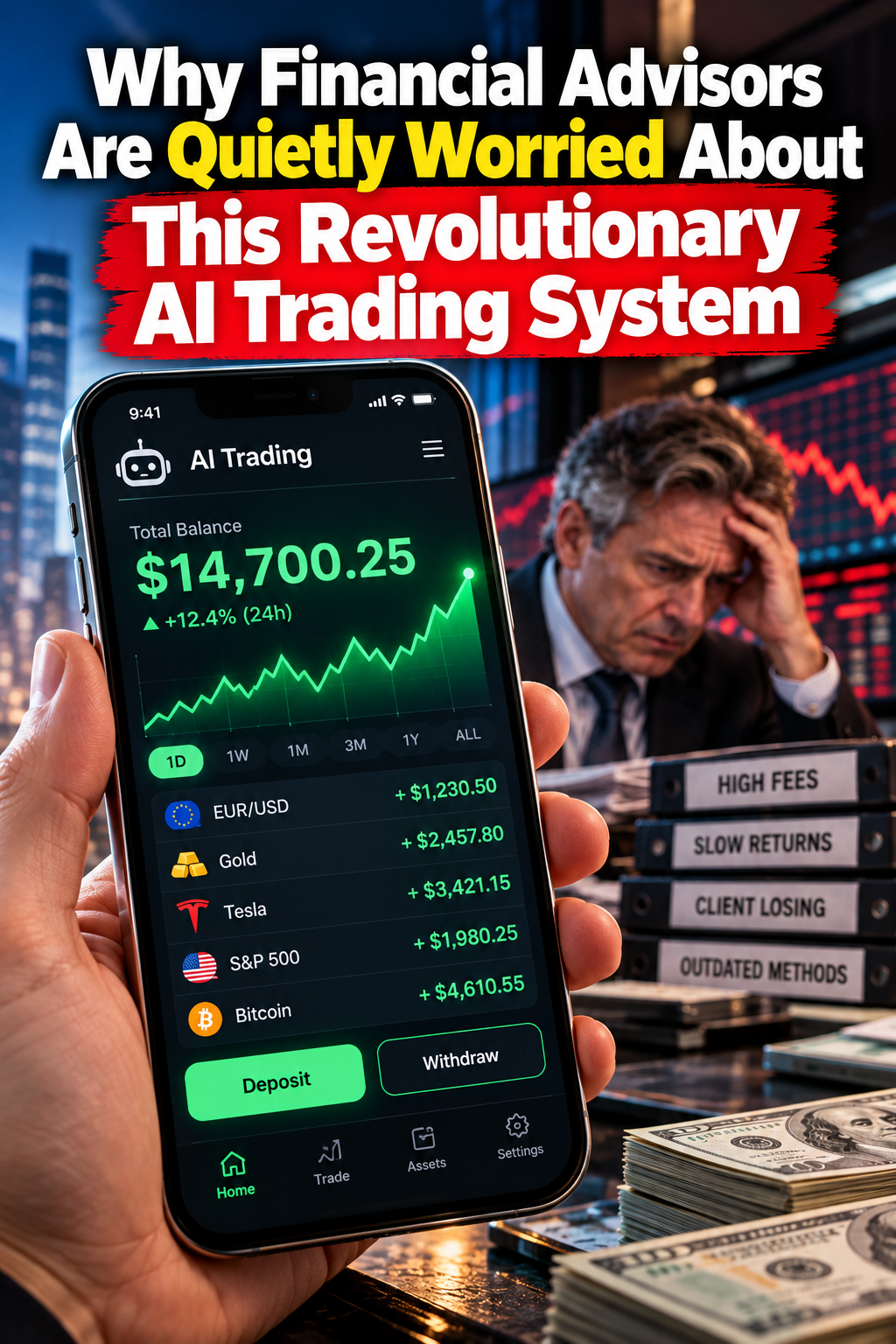
Artificial intelligence is changing how people analyze financial markets, manage investments, and make trading decisions. But could this technology reshape the role of traditional financial advisors?
FINANCE & TECHNOLOGY | October 2026 | 6 min read
A Quiet Revolution Is Taking Place in the Financial World
For decades, navigating financial markets meant relying on experienced professionals, complex analysis, and hours of research.
Investors often turned to financial advisors for guidance, portfolio management, and help interpreting market movements.
Today, artificial intelligence is introducing a very different approach.
Modern AI-powered trading platforms can analyze large volumes of financial information, identify market patterns, and assist with trading decisions in ways that were previously available mainly to institutional investors.
And as these technologies become more accessible, one question is gaining attention across the financial industry:
What happens when sophisticated financial technology becomes available to almost anyone with a smartphone?
Why AI Trading Is Attracting So Much Attention
Financial markets generate enormous amounts of information every second.
Currency fluctuations, stock movements, economic announcements, and changing investor sentiment all influence market conditions.
For an individual investor, monitoring every relevant signal is practically impossible.
Artificial intelligence offers another approach.
Instead of manually examining dozens of charts, AI systems can process information continuously and identify statistical patterns that might otherwise go unnoticed.
Depending on the platform, these technologies may support:
- Automated market analysis: Processing multiple financial indicators simultaneously.
- Algorithmic trading: Executing transactions according to predefined strategies.
- Real-time monitoring: Tracking changing market conditions throughout the trading day.
- Risk-management tools: Evaluating portfolio exposure and applying trading limits.
- Accessible dashboards: Presenting complex financial information through smartphone applications.
These capabilities help explain why algorithmic trading is becoming an increasingly important subject in personal finance.
However, sophisticated technology does not eliminate investment risk, and even advanced algorithms can produce losses.
The Smartphone Is Becoming a New Financial Control Center
Perhaps the most noticeable change isn’t happening on Wall Street.
It’s happening on people’s phones.
A new generation of financial applications is making sophisticated investment tools easier to access.
Instead of navigating complicated desktop trading terminals, users can explore markets, review financial data, and monitor portfolios through interfaces designed for everyday use.
Imagine opening an application and finding market indicators, trading activity, and portfolio performance displayed in one place.
That is the experience many modern fintech companies are working to deliver.
The real innovation is not simply automation. It is making powerful financial tools easier to understand and use.
But convenience should never be confused with guaranteed profitability.
A streamlined interface can simplify the process of investing without making the underlying markets any less unpredictable.
AI Trading vs. Traditional Financial Advisors
Does this mean artificial intelligence will replace financial advisors?
Not necessarily.
The two approaches serve different purposes, and each has important strengths.
| Feature | AI Trading Technology | Traditional Financial Advisor |
|---|---|---|
| Market analysis | Automated, data-driven | Human expertise supported by research |
| Availability | Can operate continuously | Typically scheduled consultations |
| Decision-making | Algorithms and predefined rules | Professional judgment |
| Personal guidance | Depends on the platform | Tailored advice and financial planning |
| Emotional influence | Rules-based execution | Human judgment and behavioral coaching |
| Main limitation | Model errors and market uncertainty | Cost, availability, and human limitations |
AI systems may be particularly effective at processing information and executing repetitive tasks.
Human advisors, however, can help people understand their financial goals, prepare for major life decisions, consider tax implications, and manage their emotional reactions during market downturns.
In many cases, the future may involve combining both approaches rather than choosing only one.
Why Traditional Finance Is Being Forced to Adapt
The growing interest in financial automation reflects a broader shift in consumer expectations.
People increasingly expect financial services to be accessible, transparent, and available through their phones.
They want to understand what is happening with their money without navigating unnecessarily complicated systems.
Technology companies have recognized this demand.
AI-driven financial tools are evolving from specialized software into consumer-facing products.
For traditional financial institutions, this creates both pressure and opportunity.
Advisory businesses may need to demonstrate greater value beyond basic market monitoring and routine investment transactions.
At the same time, advisors who integrate artificial intelligence into their workflows may be able to deliver more efficient and personalized services.
The competition may ultimately be less about humans versus machines and more about which approach provides the best experience and outcomes for investors.
Can Artificial Intelligence Really Improve Trading?
This is where the conversation becomes more complicated.
AI can identify relationships in historical market data, test strategies, and automate certain decisions.
But financial markets are influenced by unexpected events, changing economic conditions, and human behavior.
A trading strategy that performed well in the past may fail when market conditions change.
AI models can also overfit historical data, producing impressive backtesting results that do not translate into real-world performance.
This is why extraordinary profit claims deserve careful scrutiny.
Before using an AI trading service, investors should understand how the system operates, whether the provider is appropriately authorized, what fees apply, and whether independently verified performance information is available.
Any platform promising consistently high returns with little or no risk should be approached cautiously.
Five Questions Worth Asking Before Trying an AI Trading Platform
1. How does the system make decisions?
Look for a clear explanation of the trading strategy, its limitations, and the degree of human oversight involved.
2. What are the potential risks?
Understand whether the platform uses leverage, derivatives, cryptocurrencies, or other instruments that can produce substantial losses.
3. Who operates the platform?
Review the company’s legal identity, applicable regulatory status, and available customer protections.
4. How are funds and withdrawals handled?
Check where customer funds are held, which withdrawal conditions apply, and whether fees or restrictions exist.
5. Are performance claims independently verified?
Testimonials, simulated returns, and screenshots are not substitutes for independently audited results.
These questions can help distinguish useful financial technology from exaggerated marketing promises.
What Comes Next for AI-Powered Finance?
Artificial intelligence is unlikely to disappear from financial markets.
Its role in financial research, portfolio analysis, fraud detection, risk management, and automated execution is already substantial.
What remains uncertain is how successfully consumer trading applications will translate these capabilities into better financial outcomes.
Some platforms may help users make more informed decisions.
Others may place complex trading strategies behind interfaces that appear simpler and safer than they really are.
The challenge for the industry will be balancing innovation with transparency, oversight, and responsible risk management.
The Bottom Line
The rise of AI trading represents an important development in financial technology.
It is challenging assumptions about how investment research should be performed, how financial tools should be delivered, and which services consumers are willing to pay for.
Traditional financial advisors are not necessarily becoming obsolete.
But the expectations of investors are changing.
And as artificial intelligence becomes more integrated into everyday financial applications, both technology providers and established advisory firms will need to respond.
The future of finance may not belong exclusively to AI or traditional advisors. It may belong to those who combine intelligent technology with sound financial judgment.
Disclaimer: This article is for informational purposes only and does not constitute financial or investment advice. Trading and investing involve risk, including the possible loss of capital. Past performance does not guarantee future results.